Why Your Kitchen Knife Is Working Against You (And Why That's Not Your Fault)
- dougkatz8
- Jun 26
- 5 min read
I want to say something before I get into the science.
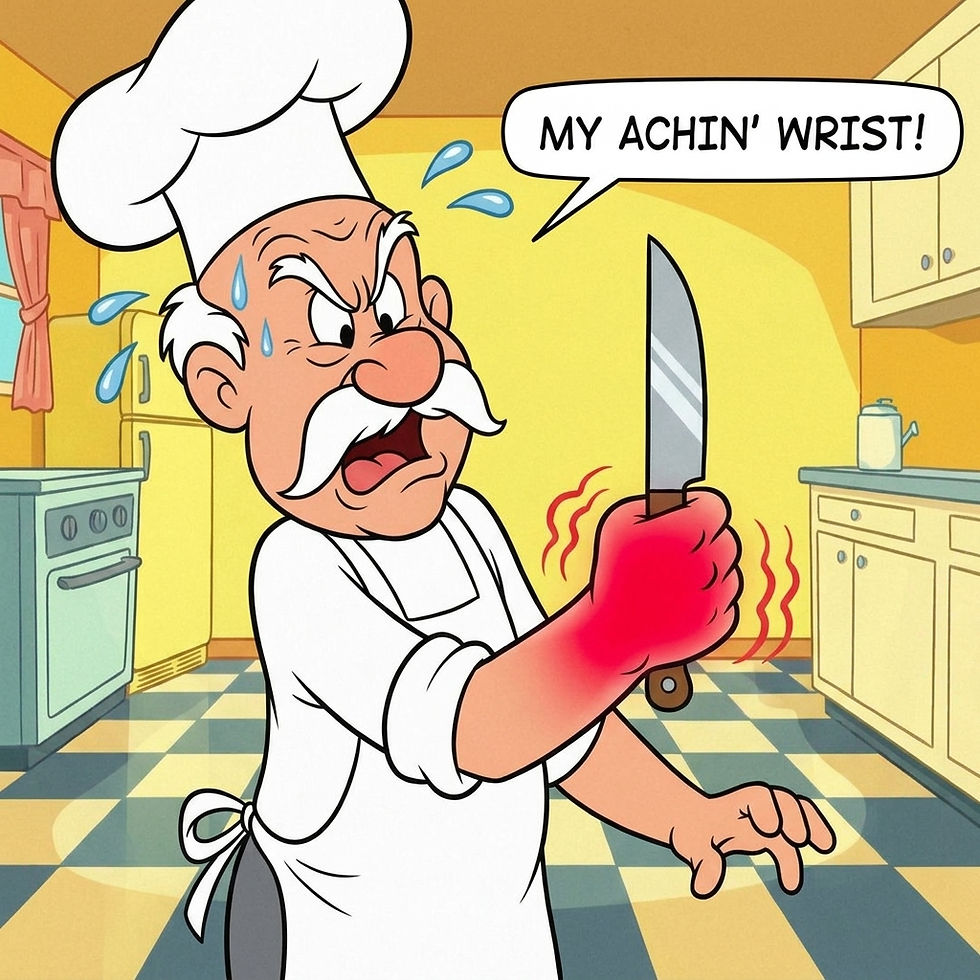
I’ve watched people blame themselves for struggling in the kitchen. Good cooks. Experienced cooks. Their hands hurt, they’re slower than they used to be, and they assume that’s just what happens — you get older, things get harder, you adapt. They work around the tool instead of asking whether the tool is the problem.
It is. The tool is the problem.
Why Standard Kitchen Knives Cause Wrist Pain and Joint Strain
Here’s what’s actually happening when you pick up a traditional knife.
Your body moves power in a chain. Legs to core to shoulder to hand. Watch a pitcher wind up. Watch a boxer throw a straight punch. The force doesn’t start in the wrist — it travels through the wrist. When that chain is straight, the movement is efficient. When it’s broken, something has to absorb the load that wasn’t designed to.
With a standard knife, that something is your wrist.
The handle geometry forces your wrist into what doctors call ulnar deviation — bent downward, off-axis from your forearm. You’re not cutting through a sweet potato anymore. You’re slapping at it. If you have osteoarthritis or rheumatoid arthritis, you feel that as sharp pain. If you’re a line cook on hour eight of a ten-hour shift, you feel it as a dull ache you’ve learned to ignore.
Neither of those is normal. Both of them are the knife’s fault.
How the NULU Knife Supports Joint Protection and Neutral Wrist Alignment
NULU fixes the chain.
The handle sits directly over the blade — same alignment as a hammer over a nail. Your wrist stays neutral. Same position as a handshake. Same position as a straight punch. Force moves from your shoulder through your hand to the food. No compensation. No load on a joint that can’t handle it.
And because the handle is built for a relaxed, open grip — not a white-knuckle squeeze — you’re steering, not strangling. Think about driving. If you’re gripping the wheel that hard, your hands cramp in ten minutes. The same thing happens in the kitchen. We just don’t talk about it.
Now — About the Ability Curve.
This is the part I want you to actually sit with, because it’s not a marketing phrase. It’s the thing that changes how you should think about every tool in your house.
Here’s the truth: ability is not fixed. It moves.
It changes with age. With injury. With fatigue. With pain. With whether you slept last night. With whether you’re holding a baby in your other arm. A person who moves through the world one way at 25 does not move through it the same way at 45, 65, or 85. Biology wins. It always does.
That’s the part we keep resisting.
We talk about disability like it belongs to some other group — over there, separate from us. Adaptive products are for “those people.” Special needs. Different category. But that’s not how bodies actually work. If you live long enough, you will need help somewhere. Strength changes. Range of motion changes. Endurance changes. What used to feel automatic starts asking for compensation.
That’s the Ability Curve.
It’s not a category of people. It’s a condition of being human. And every single one of us is on it — somewhere — right now.
Once you see that, the whole question changes.
You stop asking, “Is this product for disabled people or for me?” and start asking the better question: Does this tool work with my body, or against it? Because the answer to that one matters whether you’re 30 or 80, whether you have osteoarthritis or rheumatoid arthritis or neither, whether you’re cooking dinner or running a kitchen.
The 80-year-old grandmother with arthritis and the 25-year-old line cook on hour nine are not living the same life. But they are dealing with the same truth — a tool that fights the body creates mismatch. One person feels it now. The other feels it later. Same curve. Different place on it.
NULU is not built for “those people.” It’s built around a reality all of us are headed toward — or already living inside.
Ergonomic Kitchen Tips for Joint Protection and Energy Conservation
A few quick wins while you’re at it — occupational therapists have been teaching these principles of joint protection and energy conservation for years, and they’re right:
Keep your knives sharp. A dull knife makes you work harder. A sharp one is actually safer.
Put a non-slip mat under your cutting board. One less thing to fight.
Sit down to prep when you can. It saves more energy than you’d think.
Break the prep into pieces. You don’t have to do it all at once.
And if your knife is still working against you after all that — that’s not a you problem. That’s a tool problem.
Fix the tool.
Medical Disclaimer: This article is for educational purposes only and is not a substitute for medical advice. If you have osteoarthritis, rheumatoid arthritis, or another hand condition, please consult your physician or a licensed occupational therapist for guidance specific to your situation.
Frequently Asked Questions
Q: Why do my hands and wrists hurt when I use a kitchen knife?
Most standard kitchen knives force your wrist into a position called ulnar deviation — bent downward and off-axis from your forearm. This breaks the body’s natural kinetic chain, shifting load onto the wrist joint instead of distributing force from the shoulder through the hand. For people with osteoarthritis or rheumatoid arthritis, this misalignment causes sharp pain. For everyone else, it causes the dull ache you’ve learned to ignore.
Q: Is the NULU knife good for people with arthritis?
Yes. The NULU knife is specifically designed around the principles of joint protection that occupational therapists recommend for people with osteoarthritis and rheumatoid arthritis. The handle sits directly over the blade, keeping the wrist in a neutral position — the same as a handshake — so force travels from the shoulder through the hand to the food without loading the wrist joint. The relaxed, open grip design also eliminates the white-knuckle squeeze that causes hand cramping and joint stress.
Q: What makes a kitchen knife arthritis-friendly?
An arthritis-friendly kitchen knife should do three things: keep the wrist in a neutral position, allow a relaxed open grip rather than a tight squeeze, and align the handle so force moves efficiently through the kinetic chain without compensating at the joint. A sharp blade also matters — a dull knife forces you to work harder, which increases joint load and fatigue.
Q: Do I need to have arthritis to benefit from an ergonomic kitchen knife?
No. Wrist strain from poor handle geometry affects everyone — from line cooks on hour nine of a shift to home cooks who prep daily. The Ability Curve means that ability changes with age, fatigue, injury, and pain. A tool that works with your body rather than against it benefits you whether you have a diagnosed condition or not. The 25-year-old and the 80-year-old are on the same curve — just at different points.
Q: What else can I do to reduce hand and wrist pain while cooking?
Occupational therapists recommend several energy conservation and joint protection strategies alongside using the right tools: keep your knives sharp, place a non-slip mat under your cutting board, sit down during prep when possible, and break prep work into smaller sessions rather than doing it all at once. These habits reduce cumulative joint load and help you cook longer with less pain.


Comments