When Your Hands Hurt, Cooking Shouldn’t: How NULU Knives Help People With Arthritis Get Back in the Kitchen
- dougkatz8
- Jun 26
- 7 min read
Why NULU Wins for Arthritic Hands — At a Glance
If you’re skimming, here’s the short version:
Designed for a relaxed grip — no painful tight fist required- Keeps your wrist straight — follows clinical joint protection guidelines
The knife does the work — less pressure, less pain, less fatigue
Built on the Ability Curve — works for arthritic hands AND everyone else
Backed by clinical science — not just marketing claims
Keep reading for the full story, the clinical research behind it, and why a 200-year-old knife design has been failing 54 million Americans.
The Problem Nobody Talks About at Dinner
If you have arthritis, you already know the truth: your hands have good days and bad days. On the bad days, even simple things hurt. Opening a jar. Buttoning a shirt. And one of the hardest of all — using a kitchen knife.
Here’s something surprising. The knife sitting in your drawer right now? It was probably designed about 200 years ago. The shape hasn’t really changed. That works fine for some people. But for the 54 million adults in the U.S. living with arthritis, that old design can turn cooking from a joy into a painful chore.
This article explains why regular knives hurt arthritic hands, what the science says about it, and how the NULU knife was built from the ground up to fix the problem.
What Arthritis Actually Does to Your Hands
Arthritis is a word that covers more than 100 conditions. The two most common kinds that affect hands are:
- Osteoarthritis — the cushioning inside your joints wears down, so bones grind on bones.- Rheumatoid arthritis— your body’s defense system attacks your own joints by mistake, causing swelling and damage.
Either way, the result is the same: pain, stiffness, weakness, and less grip strength. Clinical research shows that people with hand arthritis can lose up to half of their grip strength compared to healthy adults (Kendall et al., 2005; Magee, 2014). That’s a big deal when you’re trying to hold something sharp and push down at the same time.
Hand therapy experts also point out that arthritic hands struggle with three things in particular:
1. Pinch grip — holding small things between fingers
2. Power grip— squeezing hard3. Repetitive motion — doing the same thing over and over
Guess what cutting an onion requires? All three. At the same time (Cooper, 2014; Skirven et al., 2021).
What Is the Best Knife for Someone With Weak Grip Strength?
This is one of the most-asked questions online — so let’s answer it head-on.
The best knife for weak grip strength has four things going for it:
1. A handle you can hold without squeezing hard— so your finger joints aren’t fighting you the whole time.
2. A wrist-neutral angle— meaning your wrist stays straight instead of bending down toward the cutting board.
3. Efficient force transfer — the blade geometry does the cutting work, not your shoulder and arm (Katz, 2024).
4. A stable, non-slip grip — because confidence matters when there’s a sharp edge involved.
Traditional chef’s knives miss on all four counts. Adaptive options like the Alaskan Ulu and rocker knives get closer — and we’ll talk about those next.
Why Regular Knives Make Arthritis Worse
Let’s break down what happens when someone with arthritis picks up a traditional chef’s knife.
1. The Grip Is All Wrong — A normal knife handle is a straight tube. To hold it tight, your fingers have to curl into a fist and squeeze hard. For an arthritic hand, that grip position is exactly the one that hurts the most. Joint protection guidelines say you should avoid tight grips and prolonged squeezing whenever possible (Hammond, 2004; Melvin & Jensen, 1998).
2. Your Wrist Bends in a Bad Way — When you cut on a cutting board with a regular knife, your wrist has to bend down and sideways. Studies on joint mechanics show this position puts a lot of stress on the wrist and finger joints (Levangie & Norkin, 2011). Over time, that stress causes more pain and more damage.
3. You Have to Push Down Hard — Most knives are dull-ish and shaped in a way that makes you do the work. Your shoulder, arm, and hand all have to push. For someone with arthritis or low endurance, this drains energy fast. Occupational therapists call this an energy conservation problem — and it’s a real concern for people with arthritis, MS, and other chronic conditions (Mathiowetz, Matuska, & Murphy, 2001; Radomski & Trombly Latham, 2014).
4. It’s Just Plain Dangerous — Weak grip plus slippery handle plus sharp blade equals a recipe for accidents. The American Occupational Therapy Association lists kitchen safety as a top concern for adults with hand conditions (AOTA, 2020).
NULU vs. Traditional Adaptive Knives: The Ulu and the Rocker
If you’ve already done some Googling, you’ve probably run into two famous “arthritis knives”: the Alaskan Ulu and the rocker knife. Both have been around for a long time, and both are real improvements over a regular chef’s knife. But neither one is the finish line.
The Alaskan Ulu
The Ulu has a curved blade with the handle right above it, so you can rock and chop one-handed. It’s been used by Indigenous Arctic communities for thousands of years and it works — especially for people with limited coordination.
The catch: the Ulu was designed for cutting on a flat board with a downward chopping motion. It doesn’t slice well, it’s not great for big vegetables, and the grip still requires a closed fist.
The Rocker Knife
Rocker knives use a curved blade that rocks back and forth, so you don’t have to push down as hard. Occupational therapists have recommended them for decades.
The catch: most rocker knives are designed for cutting food on your plate — not for prep. They’re a dining tool more than a cooking tool.
Where NULU Fits
NULU takes the lessons from the Ulu and the rocker knife — efficient force transfer, reduced grip demand, less downward pressure — and applies them to a full-function prep knife that handles everything from onions to butternut squash. It’s the next generation of that adaptive logic, designed for the modern kitchen and modern cooks.
How NULU Knives Fix It
NULU was designed using something called the Ability Curve — the idea that everyone’s abilities change over time, and good tools should work for people across that whole curve, not just the strongest users (Katz, 2025). Here’s how that design thinking shows up in the actual knife.
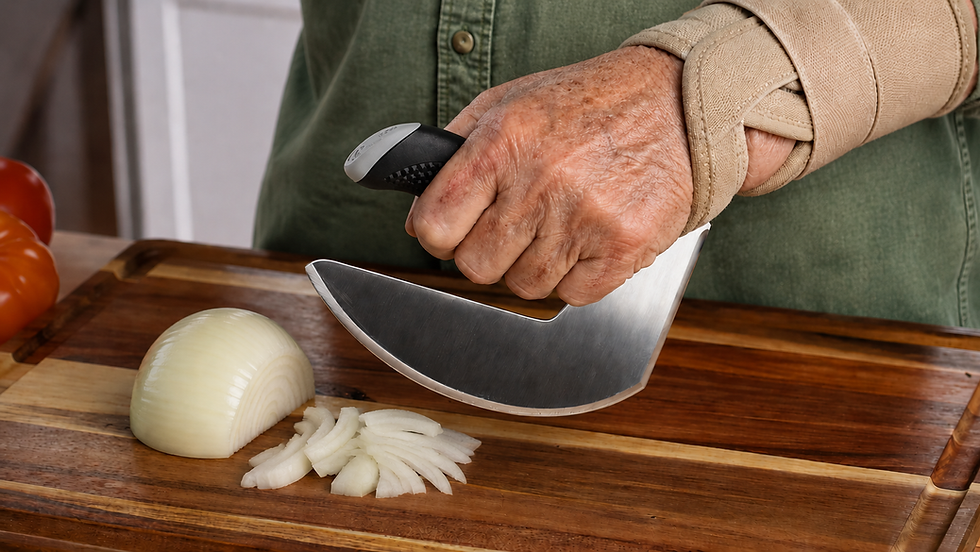
A Handle That Fits a Relaxed Hand - The NULU handle isn’t a straight stick. It’s shaped so your hand can hold it in a natural, relaxed position — no tight fist required. This follows hand therapy guidelines for joint protection: keep joints in their neutral, comfortable position whenever you can (Skirven et al., 2021).
Your Wrist Stays Straight - Because of the angle of the blade and handle, your wrist doesn’t have to bend down to cut. It stays in line with your forearm. This is the same principle taught in clinical ergonomics: a straight wrist is a happy wrist (Levangie & Norkin, 2011; Magee, 2014).
The Knife Does the Work, Not You - NULU’s blade geometry transfers force more efficiently, so you don’t have to press down as hard. Less pushing means less pain, which means more energy left for the rest of your day. This matches what occupational therapists recommend for energy conservation and fatigue management (Mathiowetz, Matuska, & Murphy, 2001; Hammond, 2004).
Safer for Weaker Hands - The grip is stable even when your hand isn’t at full strength. That means fewer slips and a lot more confidence — which, honestly, is half the battle when you’re cooking with arthritis (AOTA, 2020).
How Do I Make Cooking Easier With Arthritis?
Beyond your knife, here are quick wins occupational therapists recommend:
- Take breaks. Don’t try to prep a whole meal in one go. Rest your hands between tasks.- Use a non-slip mat under your cutting board so it doesn’t slide.- Keep your knives sharp. A dull knife makes you work harder. A sharp one is actually safer.- Sit down to prep when you can. Saves energy and reduces full-body fatigue (Radomski & Trombly Latham, 2014).- Try an adaptive knife like NULU that was built for hands like yours.
Why This Matters Beyond Arthritis
Here’s the cool part. A knife designed for arthritic hands turns out to be a better knife for everyone. Chefs with healthy hands report less fatigue at the end of a long shift. Older adults can keep cooking independently. People recovering from injuries get back to the kitchen sooner.
This is the heart of universal design: when you build something to work for people at the harder end of the ability curve, it usually works better for everyone else too (Katz, 2025).
The Bottom Line
Arthritis changes a lot of things, but it doesn’t have to take cooking away from you. The problem was never your hands. The problem was the tool.
NULU knives prove that when you design with real people in mind — people with sore joints, weaker grips, and busy lives — you end up with something better for everyone.
Your hands have done a lot for you. It’s time you had a knife that gives back.
Medical Disclaimer: This article is for educational purposes only and is not a substitute for medical advice. If you have arthritis or another hand condition, please consult your physician or a licensed occupational therapist for guidance specific to your situation.
Clinical References
American Occupational Therapy Association. (2020). Occupational Therapy Practice Framework: Domain and Process (4th ed.). AOTA Press.
Cooper, C. (Ed.). (2014). Fundamentals of Hand Therapy: Clinical Reasoning and Treatment Guidelines for Common Diagnoses of the Upper Extremity (2nd ed.). Elsevier.
Hammond, A. (2004). Joint Protection and Fatigue Management. Arthritis Research UK.
Kendall, F.P., McCreary, E.K., Provance, P.G., Rodgers, M.M., & Romani, W.A. (2005). Muscle Testing and Function with Posture and Pain (5th ed.). Lippincott Williams & Wilkins.
Levangie, P.K. & Norkin, C.C. (2011). Joint Structure and Function: A Comprehensive Analysis (5th ed.). F.A. Davis.- Magee, D.J. (2014). Orthopedic Physical Assessment (6th ed.). Elsevier.
Mathiowetz, V., Matuska, K.M., & Murphy, M.E. (2001). Energy conservation for people with MS. American Journal of Occupational Therapy.
Melvin, J.L. & Jensen, G.M. (Eds.). (1998). Rheumatologic Rehabilitation: Assessment and Management. AOTA Press.
Radomski, M.V. & Trombly Latham, C.A. (Eds.). (2014). Occupational Therapy for Physical Dysfunction (7th ed.). Wolters Kluwer.
Skirven, T.M., Osterman, A.L., Fedorczyk


Comments