When Chopping Hurts: Why Traditional Kitchen Knives Fail People with Arthritis
- dougkatz8
- Jul 15
- 9 min read
Updated: Jul 21
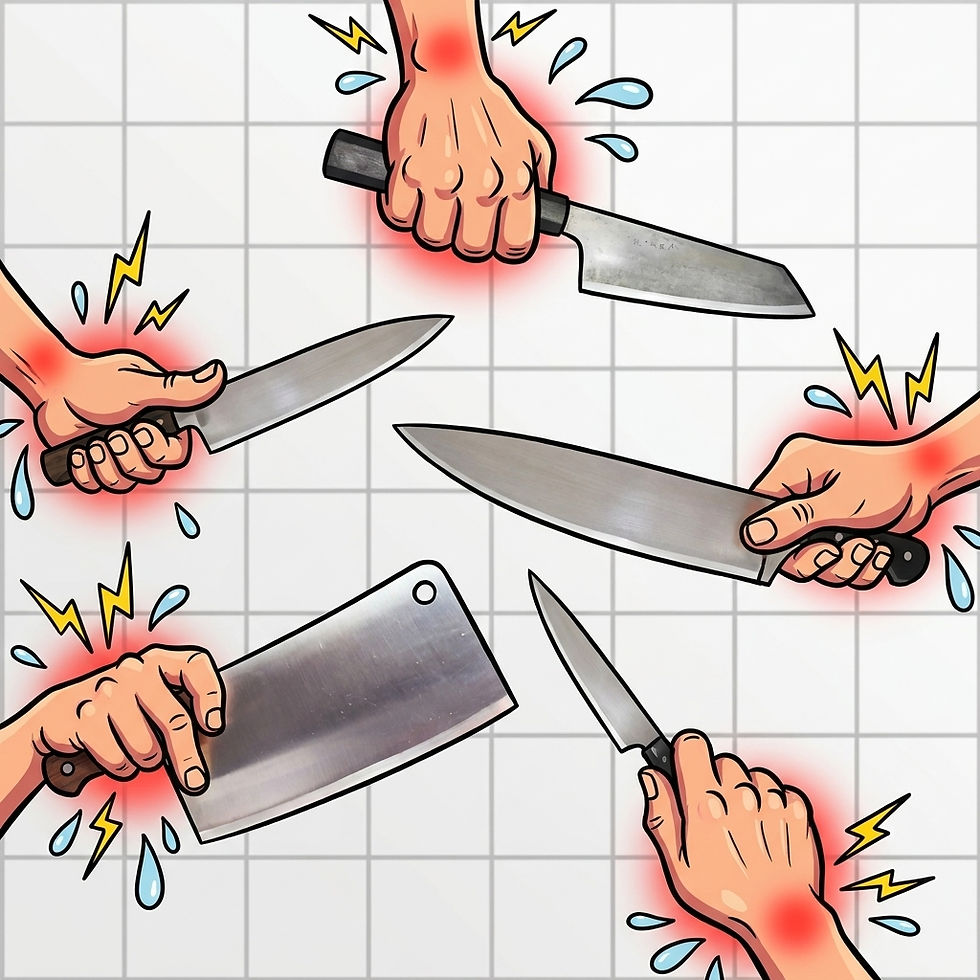
Part 1 of a 2-part series on adaptive cutting solutions for arthritis and reduced grip strength
If you have arthritis and you've started dreading meal prep, you're not imagining things — and you're not alone. For the roughly 54 million American adults living with arthritis — including osteoarthritis, rheumatoid arthritis, and psoriatic arthritis — the humble kitchen knife has become one of the most surprisingly hostile tools in the home. Not because your hands are failing you. Because the knife was engineered for a grip your arthritic joints were never designed to sustain.
As an occupational therapist, I've spent years working with clients who tell me some version of the same story: "I used to love cooking. Now the arthritis in my hands makes it unbearable." The loss isn't just culinary. It's independence, identity, the quiet ritual of feeding the people you love. And almost every time, the culprit isn't the arthritis progressing faster than expected. It's a tool assumption baked into every chef's knife on the market.
Let's talk about why traditional knives and arthritis are a fundamentally incompatible match — and what the adaptive kitchen tool industry has learned about fixing it.
The Pinch Grip: A Perfect Storm for Arthritic Joints
Walk into any culinary school and you'll be taught the same thing: the pinch grip. Thumb and index finger squeeze the blade just in front of the bolster, while the remaining three fingers wrap the handle. It's the industry standard for a reason — it gives professional chefs precision and control.
It's also a biomechanical disaster for hands with arthritis.
Here's what's happening inside your hand when arthritis meets the pinch grip:
Your DIP joints are under sustained load. The DIP joints — distal interphalangeal, the small joints closest to your fingernails — are the ones osteoarthritis targets first and most aggressively. They're where Heberden's nodes form (those bony bumps common in hand osteoarthritis). The pinch grip asks these already-inflamed arthritic joints to hold a squeeze for the entire duration of a cut. Not a quick pinch. A sustained, static contraction — exactly the loading pattern that flares arthritis pain.
Your CMC joint is working as a hinge. The CMC joint — carpometacarpal, at the base of your thumb — is the second most common site for hand osteoarthritis, especially in women over 40. It's so commonly affected it has its own name in the clinical literature: thumb basal joint arthritis. Every forward-slicing motion of a traditional knife turns this already-vulnerable arthritic joint into a pivot point. Open, close, open, close. Sixty times to dice an onion.
Rheumatoid arthritis adds a second layer of damage. While osteoarthritis wears down cartilage mechanically, rheumatoid arthritis (RA) causes systemic inflammation of the synovial lining — including in the MCP joints (the large knuckles) and the wrist. For RA patients, the pinch grip doesn't just stress joints; it drives an inflammatory cascade that can extend a flare for days after a single cooking session.
Recent reporting from Serious Eats polled 30 professional chefs about their grip preferences, and buried in that piece are two admissions that should stop anyone with arthritis in their tracks [1]:
"One downside is the permanent callus on my index finger because of the repeated friction with the knife." — Chef Niven Patel
"I used to grip the handle exclusively, and I developed pain in my wrist." — Chef Rachel Klein
These are chefs. Working professionals with healthy hands, peak grip strength, decades of technique, and the finest knives money can buy. The tool is still hurting them.
If the industry-standard grip causes chronic pain and permanent tissue damage in healthy hands, imagine the compounded impact on hands where arthritis has already compromised the cartilage, synovium, and surrounding soft tissue.
The Seesaw in Your Hand: Why Arthritis, Lever Arms, and Wrist Deviation Don't Mix
Here's where a simple analogy helps explain why arthritis pain gets worse the longer you chop.
Picture a seesaw at a playground.
The long blade of a chef's knife is the plank. Your wrist is the fulcrum in the middle. Your hand gripping the handle sits on one end. The cutting edge striking the board hits on the other.
Every time that blade impacts the cutting board, the force of that impact travels back up the plank and lands squarely in your wrist. The longer the blade, the longer the lever arm, the more force your wrist absorbs.
For a healthy 25-year-old line cook, this is manageable. For someone with arthritis in the wrist or thumb, the math changes completely. Inflamed synovial tissue can't dissipate repetitive force. Each chop deposits micro-trauma into an already-arthritic joint — which is why so many people with arthritis notice their hands feel dramatically worse the day after cooking, not just during.
Here's the part most people miss: the handle of a traditional chef's knife sits behind and below the blade, not directly above it. This forces your wrist out of its neutral position — the straight, relaxed alignment where joints are under the least stress — and into radial deviation, a tilt toward the thumb side of the wrist. Occupational therapists identify this as one of the primary triggers for arthritis flares during kitchen tasks.
So you're not pressing straight down. You're pressing down and forward, with your wrist cocked at an angle — which means the CMC joint at the base of your thumb is doing double duty. It's absorbing lever-arm shock and acting as the hinge for that forward motion. Two of the most arthritis-prone joints in the entire hand, doing the two most painful things they can do, on repeat, for as long as dinner prep takes.
A note on blade weight: This is where arthritis type matters. Some people with osteoarthritis find that a heavier blade actually helps — the weight does some of the downward work, reducing the force they need to apply. But for rheumatoid arthritis patients, where shoulder and elbow joints are often also affected, a heavy blade compounds fatigue up the entire kinetic chain. Lightweight Japanese-style blades reduce shoulder strain but demand more wrist force to cut through dense vegetables. Neither solves the underlying geometry problem — they just shift where the arthritis tax gets paid.
The Handle Material Problem: When "Easy to Hold" Isn't Enough
Most adaptive kitchen tools marketed to arthritis sufferers focus on one thing: making the handle easier to grip. Rubberized coatings, silicone sleeves, contoured foam — these are the standard interventions, and they do help with one specific problem: reduced grip friction.
For arthritis patients with decreased hand strength or reduced sensation, a non-slip, oversized handle is genuinely useful. It means you don't have to squeeze as hard to maintain control. That's real.
But here's what the handle-material approach misses: it doesn't change the geometry. A rubberized handle on a traditional chef's knife still requires the pinch grip. It still loads the DIP and CMC joints. It still forces the wrist into radial deviation. It still creates lever-arm shock through the wrist with every chop.
Making the grip more comfortable is not the same as making the cutting mechanics safer for arthritic joints. One addresses the symptom. The other addresses the cause.
The most effective adaptive kitchen knives for arthritis don't just change what the handle is made of — they change where the handle sits relative to the blade, and what muscles are doing the work.
What the Chefs Are Really Telling Us About Arthritis Risk
Read the Serious Eats piece carefully and something remarkable emerges. Those 30 chefs don't actually agree on the "correct" grip. Some pinch the blade. Some pinch the bolster. Some run their index finger along the spine. Some grip the handle like a hammer for tougher vegetables. Chef Joshua Pinsky openly switches between grips specifically to give his hands a break [1].
Nobody stays in one position. Because no one position works for long.
From a clinical standpoint, this constant grip-cycling is exactly what we'd predict. When a tool's geometry creates sustained joint stress, users unconsciously develop compensatory strategies — shifting load, changing angles, taking micro-rests. Chefs have the muscle mass and pain tolerance to mask this compensation as "technique." People with arthritis don't have that luxury. When arthritic hands hurt, they simply stop cooking.
That's the piece that matters. The traditional knife isn't neutral toward arthritis. It's actively selecting for who gets to keep cooking — and quietly disqualifying anyone whose joints can't absorb the compounding damage.
Reframing the Problem: It's the Knife, Not Your Arthritis
If you have arthritis and you've been telling yourself any of these things, I want to gently push back:
"I just need a sharper knife." Sharpness reduces the force needed to cut, but it doesn't change the pinch-grip requirement, the lever-arm geometry, or the wrist deviation. A razor-sharp chef's knife still asks your arthritic DIP and CMC joints to do the same painful work.
"I just need a better grip — maybe a rubberized handle." Handle material helps with grip friction, but it doesn't change the cutting mechanics. You're still pinching, still deviating, still absorbing lever-arm shock through an arthritic wrist.
"I just need to grip harder." The grip is the arthritis trigger. More force on inflamed joints produces more inflammation, not more control.
"My mother managed with a regular knife her whole life." Perhaps. She also likely stopped cooking earlier than she wanted to, or accepted a level of daily arthritis pain we now know isn't necessary. Adaptive kitchen tools aren't about weakness. They're about not paying a joint tax to feed yourself.
The problem isn't your arthritis. The problem is a 300-year-old knife design that assumes a level of sustained grip strength most adults over 60 no longer have — that arthritis actively removes — and that even professional chefs quietly struggle with.
Frequently Asked Questions About Arthritis and Kitchen Knives
Q: Why does chopping vegetables make my arthritis worse?
A: The pinch grip required by traditional chef's knives loads the DIP joints (fingertips) and CMC joint (thumb base) — the two areas most commonly affected by hand arthritis. Sustained squeezing, combined with wrist radial deviation and repetitive lever-arm shock, compounds inflammation with every cut.
Q: How can I chop vegetables if I can't fully close my fist?
A: Traditional knives require a sustained pinch grip that depends on full finger flexion. Adaptive kitchen knives with centered handles and ergonomic geometry allow cutting through downward pressure rather than grip strength — shifting the workload to the forearm and shoulder instead of the finger joints.
Q: Is a rocker knife good for arthritis?
A: Rocker knives help with the downward-force problem but often introduce new issues around wrist alignment, visibility, and versatility. Part 2 of this series compares rocker knives, 90-degree adaptive handles, and newer centered-handle ergonomic designs specifically engineered for arthritic hands.
Q: What is the difference between a rocker knife and an ulu knife for arthritis?
A: Both eliminate the forward-slicing motion that stresses the CMC joint, but they differ significantly in wrist position, blade visibility, and the range of cuts they can perform. Part 2 covers this comparison in detail.
Q: Can rheumatoid arthritis patients still cook independently?
A: Yes — but usually not with traditional kitchen knives. RA-friendly adaptive cutting tools eliminate the sustained pinch grip and redistribute force away from the small finger joints toward the larger muscles of the forearm and shoulder, keeping the wrist in a neutral position throughout the cut.
Q: What's the difference between osteoarthritis and rheumatoid arthritis when it comes to knife use?
A: Osteoarthritis primarily affects the DIP and CMC joints through mechanical wear, making the pinch grip and lever-arm shock the main problems. Rheumatoid arthritis affects the MCP joints and wrist through systemic inflammation, meaning both the grip and the wrist deviation become problematic. Both conditions benefit from adaptive knife geometry that maintains a neutral wrist position.
Q: Does blade weight matter for arthritis?
A: Yes — and it depends on your arthritis type. Heavier blades can reduce the force needed for downward cuts, which helps some osteoarthritis patients. But for rheumatoid arthritis patients with shoulder or elbow involvement, lightweight ergonomic knives reduce fatigue across the entire arm. Neither weight alone solves the geometry problem.
What's Next
In Part 2, we'll examine what the adaptive equipment industry has developed for arthritis sufferers — rocker knives, 90-degree handles, built-up rubber grips, and ulu-style blades — and where most of these solutions still fall short of solving the underlying arthritis biomechanics.
We'll also look at a design that takes a fundamentally different approach. Instead of changing the handle material or rotating the grip 90 degrees, it changes the geometry of the blade itself — shifting the handle directly over a 160° multi-blade edge to eliminate the lever arm entirely. It's called NULU.
NULU is already available in over 35 state Assistive Technology lending libraries across the country, where OTs and PTs can put it directly into the hands of clients as part of formal rehabilitation programs. And beyond the clinical setting, it's been purchased by hundreds of people living with arthritis, reduced grip strength, and other hand conditions — many of whom describe it as the tool that finally gave them their kitchen back.
That kind of validation — from both rehabilitation professionals and the people actually cooking with it every day — is worth paying attention to.
Because here's the truth every OT eventually tells a client with arthritis: you don't have to give up cooking. You just have to stop using knives that were designed for someone else's hands.
Source
[1] Eng, Jess. "We Asked 30 Chefs How They Hold a Knife—These Grips Could Improve Your Cuts." Serious Eats, October 8, 2025.


Comments