The Care Loophole
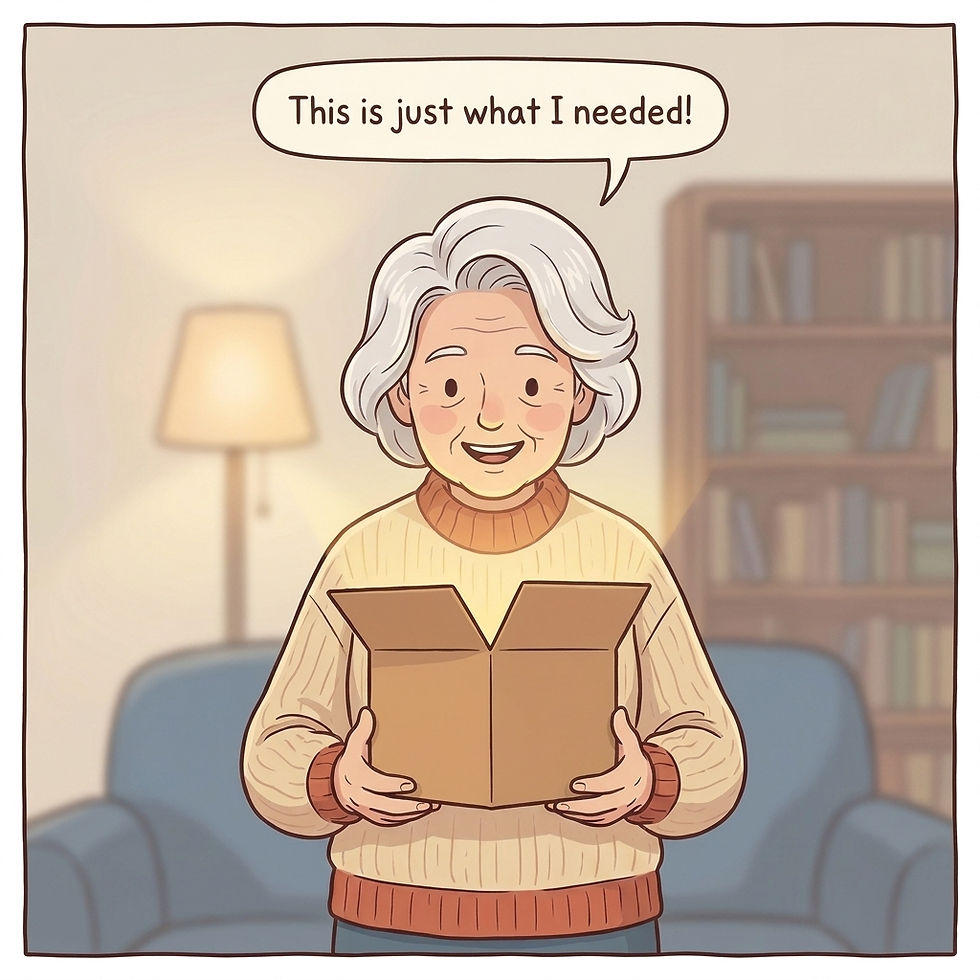
Why we accept gifts we'd never buy ourselves — and what adaptive-product brands and care-givers can learn from it.
When Margaret's daughter set the wrapped box on the kitchen table last spring, Margaret assumed it was another candle. She was seventy-eight, her birthdays had become predictable, and macular degeneration had quietly rearranged what she could still enjoy about them. She hadn't finished a novel in almost a year. She had stopped mentioning it.
Inside the box was a lamp — sculptural, warm-toned, more Design Within Reach than drugstore. Her daughter had researched it for weeks. It was engineered specifically for people with low vision: the right lumens, the right color temperature, the right positioning geometry to work around a failing macula.
Margaret's first words weren't "I need this." They were "Oh — it's beautiful."
Two weeks later, she was three chapters into a novel.
Here is the part worth pausing on: Margaret would never have bought that lamp for herself. Not because of the price. Because of what buying it would have meant.
This piece is written for family caregivers, adult children, and product designers working with older adults managing arthritis, vision loss, hearing loss, and the everyday adaptations of aging at home.
Why Seniors Resist the Aids That Would Help Them Most
Every adaptive product carries a hidden cost that has nothing to do with its price tag. Researchers call it self-stigma — the internal declaration a user has to make before they'll walk into a store, click "add to cart," or hand a prescription across a counter. I have crossed a threshold. I am now the kind of person who needs this.
That declaration is expensive. And it shows up in every category of aging-in-place support:
Hearing loss: Roughly 40% of adults who could benefit from hearing aids cite stigma as a top reason they don't buy them. The average delay between diagnosis and purchase runs seven to ten years.
Low vision: People with macular degeneration often stop reading, cooking, or driving long before they'll accept a magnifier or a specialized lamp.
Arthritis: A senior with painful, arthritic hands may struggle for years to open a jar, button a shirt, or use a knife — rather than buy an ergonomic jar opener, a button hook, or a purpose-built ergonomic knife like the NULU adaptive knife.
Mobility: Raised toilet seats, shower benches, and grab bars sit in family conversations for years before they arrive in the bathroom.
The pattern is remarkably consistent. Self-stigma research identifies the same set of internal fears across categories: being labeled old, being seen as diminished, being marked as other. Users report thinking things like "I am not capable" or "I am a weak person" when they contemplate purchase — cognitions that have almost nothing to do with the product itself and everything to do with the identity work required to acquire it.
The paradox for adaptive-product brands, and for the families trying to help, is this: the same person who resists purchasing will often happily use the product once it's in the home. Studies of hearing aid users have found that quality is the biggest inhibitor for existing owners, but stigma is the biggest barrier to becoming an owner in the first place. The gap between the two — between would use and will buy — is where an enormous amount of unmet need lives.
It is also where gifting quietly does its work.
How the Loophole Works
Something structurally different happens when the same product arrives wrapped, from someone who loves the recipient. Several psychological mechanisms fire at once.
The admission is externalized. The recipient never has to declare the need. Someone else declared it for them — and did so as an act of care rather than a diagnosis. The identity work is offloaded to the giver, whose intent recodes the product from clinical to personal.
The endowment effect activates without a purchase decision. Behavioral economists have shown for decades that people value items they possess more highly than identical items they don't — a bias that holds whether the item was bought or received. A recipient inherits the pro-adoption pull of ownership without ever crossing the psychological threshold of paying to acknowledge a limitation.
Self-concept is protected, sometimes repaired. One striking finding from endowment-effect research: when people feel their self-concept is threatened, they rate gifted items more positively than they otherwise would. A well-chosen adaptive product doesn't just avoid triggering identity threat — it can actively soothe it. The gift says, in effect, I see you clearly, and I still see you as someone worth this kind of attention.
The frame flips from deficit to devotion. A jar opener Margaret's sister buys herself is evidence of arthritic decline. A jar opener her daughter gives her — tucked into a gift basket with good olive oil and a nice bottle of wine — is evidence of love. The object is identical. The meaning is not.
Aesthetics do heavy lifting. Devices that look like adaptive equipment mark the user as other. Devices that look like beautifully-designed objects allow the recipient to accept the function without accepting the category. This is why the adaptive-product world's biggest recent winners — residential-style low-vision lamps like NULU, discreet in-ear hearing aids, ergonomic kitchen tools designed by OXO rather than by medical suppliers — have moved decisively away from clinical design language. It isn't vanity. It's the mechanism that closes the loophole from the recipient's side.
The Double Loophole: Caring for the Caregiver
There is a second population the care loophole quietly serves: the caregivers themselves.
Adult children and spouses providing care for an aging parent or partner are often managing their own bodies under strain. Lifting, transferring, reaching, gripping, standing for long stretches — the physical work of caregiving is real, and a significant portion of family caregivers are themselves in the age range where arthritis, back pain, and joint wear are already present.
They tend to ignore it. The focus is on the person being cared for, and admitting their own physical limits feels like a second failure on top of the first.
The care loophole works in this direction too. When a sibling gifts a caregiver an ergonomic transfer belt, a raised gardening bed, a jar opener for the caregiver's own kitchen, or a supportive seat cushion for long hours at a parent's bedside — the caregiver receives the tool without having to declare that they, too, are reaching a limit. The gift protects their joints, their back, and their capacity to keep showing up. And it does so without asking them to make an admission they were unlikely to make on their own.
Families that recognize this create a healthier caregiving system. Brands that recognize it unlock a second market inside the first.
Why the Recipients Are So Happy
Read the reviews of any well-designed adaptive product and a pattern emerges: the most emotional testimonials almost always describe a gift experience, not a self-purchase. "I gave this to my mom and she cried." "My dad hasn't read a book in two years — he finished one last week." "My wife can open her own pill bottles again."
Three things happen in sequence once the product is in the home:
The functional benefit lands almost immediately. Reading returns. Jars open. Buttons close. Faces come back into focus.
The utility retroactively overrides the stigma that would have blocked purchase. Users often wonder aloud why they resisted for so long.
The recipient becomes an evangelist — usually for the specific brand that delivered the benefit without making them feel diminished.
That evangelism, notably, does not sound like a medical-device testimonial. It sounds like gratitude — for the giver, for the object, and for the version of themselves the product helped them return to.
What Brands Are Learning
For product designers and marketers working in adaptive categories, the care loophole reframes almost every strategic question. The user is often not the buyer. The buyer is often an adult child, a spouse, or a grandchild — and their emotional job is different. They aren't shopping for a device; they're shopping for a way to give something back to someone they love.
The implications are becoming visible across the category:
Package like a gift, not a medical device. Clinical packaging preloads stigma before the product is even unwrapped. Use gift-ready boxes, ribbon, and giftable presentation as the default — not the upgrade tier.
Sell restored activity, not the underlying impairment. "Bring reading back to the people who love it" outperforms "For macular degeneration." "Open anything again" outperforms "For arthritic hands."
Design for the living room, not the exam room. Residential aesthetics aren't a luxury; they are the adoption strategy. A product that fits the recipient's home is a product the recipient will keep out and use.
Target the giver in acquisition, the user in retention. Gift-mode SKUs, gift notes, and giver-focused testimonials drive first purchase. User community, accessories, and upgrades drive lifetime value.
Speak to caregivers as a second audience. Their bodies matter too, and products that quietly protect them earn deep loyalty.
Recognize the wedge effect. Once a recipient has accepted a gifted device and experienced the benefit, the identity work is done. They are far more likely to buy the next unit, the upgrade, or the accessory themselves.
Leveraging the Loophole Responsibly
The care loophole is powerful, which means it can be misused. Gifts that feel imposed rather than offered can backfire — recipients read paternalism as fast as they read love, and a device that arrives with the wrong framing ("you clearly need this") can deepen the very stigma it was meant to bypass. Research on device abandonment consistently finds that some form of user involvement — even light-touch — improves long-term satisfaction and use.
The best gift experiences preserve agency inside the act of care:
"I found this and thought you might love it" opens a door.
"I got this because you're struggling" closes one.
"Let's try it together this weekend" keeps the recipient in the driver's seat.
The mechanism works because it feels like devotion, not diagnosis. Brands that build for that distinction — and families who honor it — are the ones producing the reviews that begin with tears and end with a finished novel, an opened jar, a buttoned shirt, a quiet evening spent hearing every word at the dinner table.
Margaret's lamp still sits on the table beside her chair. She has finished four books since spring. She hasn't once described it as an adaptive product. She describes it as the lamp my daughter gave me.
That is the care loophole at work. And it is, quietly, one of the most important dynamics shaping the future of adaptive design — and one of the most useful tools available to any family trying to help someone they love keep the life they want.


Comments